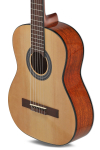
Natural acoustic sound with the option to plug in: an acoustic-electric guitar can accompany your first chords, relaxed playing at home and live performances.
A favourite song with friends, a melody of your own or accompaniment for a singer – an acoustic-electric guitar combines an acoustic instrument with a pickup, allowing you to amplify its sound. You do not need an amplifier for ordinary playing at home. For rehearsals or a larger audience, you can connect it to a suitable acoustic amplifier or PA system.
Start with comfort. The body should sit comfortably and your fretting hand should reach the fingerboard easily. Then compare construction, sound and electronics. A higher price alone does not guarantee a better fit for your hands or playing style.
| Feature | What to consider |
|---|---|
| Body shape | Dreadnought is popular for chord accompaniment. Grand Auditorium is a versatile choice for fingerpicking and strumming; the actual sound depends on the individual construction. |
| Size and scale length | Choose between full size and a more compact instrument for travel or a smaller player. An inch-based size label does not replace exact measurements or a comfort check. |
| Cutaway | A body cutaway improves access to higher frets. It is not essential for basic chord accompaniment. |
| Top construction | Laminated and solid tops differ in construction. A solid top does not mean that the entire guitar is all-solid. |
| Pickup and controls | Compare volume, tone controls and any built-in tuner. Electronics vary between models. |
| Included accessories | Check whether a gig bag is supplied. A cable, amplifier and other accessories are not automatically included. |
Beginners benefit from a comfortable neck, a manageable body size and a well-adjusted instrument. A tuner, protective bag and a few picks can be useful. Do not select a smaller guitar by age alone: the player's height and reach matter too. Always choose strings intended for the specific instrument.
For a natural amplified sound, consider an acoustic amplifier or a suitable PA input. Connecting to a mixer may require a DI box or preamp. Check the connector and the electronics' power requirements. A conventional steel-string acoustic-electric guitar uses acoustic guitar strings, while hybrid models may require something different.
Choose a bag that fits the guitar's shape and dimensions. If one is already included, there is no need to buy a second. Depending on how you play, a strap, capo, stand, picks or clip-on tuner may be useful. Protect the instrument from sudden changes in temperature and humidity.
An acoustic-electric guitar has a pickup and, depending on the model, a preamp with controls. An acoustic guitar without a pickup requires a microphone or an added pickup to amplify its sound.
Yes. A conventional acoustic-electric guitar has its own resonating body. The pickup allows amplification but is not required for normal acoustic playing.
No. Check the electronics of the individual model. If there is no built-in tuner, a clip-on tuner is one practical option.
Not necessarily. Hybrid instruments may combine electric and acoustic features, with different pickups and string requirements. Compare the construction and intended use of the specific model.
No results returned from filter