Violins are among the most popular string instruments. Their clear, singing tone, wide dynamic range and ability to express both delicate emotions and energetic musical passages make them an essential part of classical music, folk, jazz, country, pop and film music.
Whether you are learning your first notes, preparing for music school, playing in an orchestra or looking for an instrument for live performance, choosing the right violin is an important foundation for comfortable playing and musical development.
Our range includes acoustic violins, electric violins, children's violins in different sizes and complete violin sets. Information about sizes, materials, construction and accessories will help you choose the right instrument.
Acoustic violins are the traditional choice for music students, orchestral players, folk musicians and soloists. Their sound is created by vibrating strings and the natural resonance of the wooden body.
Traditional violin construction provides a broad range of tonal colours, from delicate pianissimo to powerful melodic lines and fast virtuoso passages.
Acoustic violins are suitable for classical music, chamber music, folk and many other genres. When choosing, consider build quality, materials, setup and playing comfort.
If you are interested in sound experimentation, playing in a band or modern music production, electric violins can be an attractive choice.
They use electronic vibration pickup systems and can be connected to amplifiers, mixing desks, audio interfaces and effects processors.
Electric violins are popular in rock, pop, electronic and experimental music. Some models also feature a headphone output for quieter practice.
Consider weight, ergonomics, pickup type, power requirements and available connectors.
When choosing a violin for a child, correct sizing is one of the most important factors. An instrument that is too large can make posture and technical development more difficult.
Children's violins are available in several smaller sizes. Choose according to arm length, body proportions and ideally a teacher's recommendation.
A violin set can be a convenient solution for a first instrument. Depending on the model, a set may include the violin, bow, protective case and rosin.
Some sets also include a tuner or shoulder rest. Always check the exact package contents.
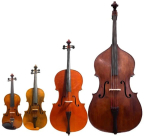
Violins are made in different sizes so that children, teenagers and adults can play comfortably. Correct sizing supports natural posture, easy access to the fingerboard and healthy technical development.
| Violin size | Typical use | Suitable for |
|---|---|---|
| 1/16 | Very small children's violin | Youngest beginners |
| 1/8 | Small children's violin | Younger children with shorter arms |
| 1/4 | Children's size | Children who have outgrown smaller sizes |
| 1/2 | Medium children's size | Younger school-age children |
| 3/4 | Larger children's size | Older children and smaller players |
| 4/4 | Full size | Most adults and older students |
Important: These recommendations are approximate. Measuring arm length and trying the instrument with a teacher is the most reliable approach.
Your first violin does not need to be the most expensive model. Correct size, reliable tuning, comfortable playability and proper setup are more important.
Pay attention to the bridge, strings, tuning pegs, fingerboard and overall build quality.
More experienced players may focus on tonal character, dynamic response, projection and comfort in technically demanding passages.
The choice of bow and strings can also have a major influence on the playing experience.
Spruce is traditionally used for the top because of its favourable combination of strength and low weight.
Maple is commonly used for the back, ribs and neck.
Ebony or other suitable materials are traditionally used for the fingerboard and selected smaller parts.
Wood species alone does not determine instrument quality. Construction, workmanship and setup are also important.
The bow has a major influence on response and musical expression.
Rosin provides the friction required between bow hair and strings.
Violin strings affect tone colour, response and playing comfort.
A suitable violin case protects the instrument during storage and transport.
The right shoulder rest and chin rest can significantly improve playing comfort.
A chromatic tuner helps tune the G–D–A–E strings accurately, while a metronome supports rhythmic precision and technique.
A correctly sized, properly set-up student violin.
Most adults use a full-size 4/4 violin.
Choose according to arm length and preferably a teacher's recommendation.
A 3/4 violin is smaller, while 4/4 is the standard full size.
A set is convenient for beginners; buying separately gives more freedom when choosing accessories.
A violin, bow, rosin, case and tuner. A shoulder rest, music stand and metronome can also be useful.
Acoustic violins rely on natural body resonance, while electric violins use electronic pickup systems.
Yes, on models equipped with a suitable headphone output.
It depends on playing frequency, wear and changes in sound quality.
It provides friction between the bow hair and strings.
Choose according to violin size, weight, balance and material.
Yes, provided the size, balance and build quality are appropriate.
In a suitable case, away from direct sunlight and sudden changes in temperature or humidity.
Yes, using a compatible pickup.
Strings compatible with the instrument size and type that provide stable tuning and comfortable response.
It depends on practice consistency, teaching method and previous musical experience.
Yes. Violin can be learned at any age.
Whether you are looking for a child's first violin, a reliable instrument for regular practice or a model for more demanding musical projects, the right choice can help you develop both technique and personal musical expression.
No results returned from filter