Violin strings are among the most important components of every violin. Together with the bow, bridge and resonating body, they play a major role in shaping the final sound of the instrument. Their material, construction, tension and condition affect tone colour, stability, projection and playing response.
Choosing the right strings depends on several factors. Beginners may prefer stable tuning and easy maintenance, while more experienced violinists often look for a particular tonal character, wider dynamic range or a specific response to different bowing techniques.
This guide explains the main types of violin strings, how they differ, how to choose the correct size and tension, and when it is time to replace them.
Even a high-quality violin needs suitable strings. Two different sets can produce noticeably different results on the same instrument and may require a slightly different playing approach.
Violin strings mainly influence:
There is no single string set that is ideal for every violinist and every instrument. The best choice balances string characteristics, the construction of the violin and the player's individual requirements.
One of the most important criteria is the core material. Violin strings are generally divided into synthetic-core, steel-core and gut-core types. They differ in construction, response, tuning stability and typical tonal character.
Synthetic-core strings are popular with students and experienced violinists alike. Their core may be made from nylon, perlon or other synthetic materials and is often combined with metal winding.
They typically provide a balanced combination of tonal colour, tuning stability and comfortable response. Depending on the model, they may sound warm, neutral or brighter and more projecting.
New synthetic strings usually require some time to settle before their tuning becomes fully stable.
Steel violin strings use a steel core made from either a single wire or multiple strands. Their characteristics depend on core construction, winding and tension.
Steel strings are often known for quick response, good tuning stability and a clear, direct tone. They are popular in folk music but are also used in many other genres and on student instruments.
Not all steel strings sound the same. Solid-core and stranded-core construction, winding materials and manufacturer design can create significant differences.
Gut strings follow the historic tradition of string making. Their core is made from natural gut and, depending on the model, may be plain or metal-wound.
Violinists value them for their characteristic tonal richness and distinctive playing feel. They are frequently used for early music, historically informed performance and also on modern instruments.
Compared with many synthetic and steel strings, gut strings are more sensitive to changes in temperature and humidity and therefore require greater attention to tuning and care.
| Property | Synthetic core | Steel core | Gut core |
|---|---|---|---|
| Typical sound | Balanced, from warm to bright depending on model | Often clear and direct | Colourful, traditional character |
| Response | Balanced | Usually fast | Depends on construction and technique |
| Tuning stability | Generally good after settling | Generally very good | More sensitive to environmental conditions |
| Typical use | Study, classical, orchestra, solo | Folk, study, various genres | Early music, historically informed performance |
| Care | Standard | Standard | Requires more attention |
These characteristics are approximate. Actual tone and response depend on the specific string model, instrument and playing technique.
Choosing the correct size is essential. Strings are designed for a particular instrument scale length, meaning the distance between the nut and bridge.
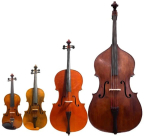
The most common are 4/4 violin strings for full-size instruments. Smaller versions are available for children's and student violins. Some manufacturers offer combined sizes such as 3/4–4/4, while others provide separate sets for each size.
| Violin size | Typical use | Recommendation |
|---|---|---|
| 4/4 | Adults and teenagers | Choose strings marked 4/4 or compatible with full-size violins. |
| 3/4 | Older children and younger students | Check for 3/4 or 3/4–4/4 compatibility. |
| 1/2 | Younger students | Use strings intended for 1/2-size instruments or a manufacturer-approved range. |
| 1/4 and smaller | Smaller children's violins | Verify compatibility with the exact violin size. |
Age recommendations for violin sizes are only approximate. The correct instrument size depends primarily on arm length and the player's body proportions. Always follow the string manufacturer's size designation.
In addition to material and size, string sets differ in tension. Manufacturers may use terms such as soft, medium and strong, or light, medium and heavy.
Lower tension: May provide a softer playing feel and different response.
Medium tension: Often serves as a versatile starting point unless another tension is recommended.
Higher tension: May provide a firmer playing feel and different tonal properties, but it is not automatically louder or more suitable for every violin.
Tension ratings are not directly comparable between all brands. If you are making a significant change, consulting a teacher or luthier can be useful.
Standard violins have four strings tuned from lowest to highest as G–D–A–E.
When combining individual strings, consider their balance as a complete set. Mixing brands and models can be useful, but the result should always be evaluated on the specific violin.
Violin strings can be purchased as a complete four-string set or individually.
A complete set is practical when replacing all strings or trying a new string model. The strings are designed to work together as a balanced system.
An individual string is useful when only one string is damaged or when you want to adjust the character of a particular register. The E string is a common example.
If the remaining strings are already heavily worn, replacing the entire set may produce a more balanced result.
For beginners, it is important that the violin responds well to the bow, stays in tune reliably and does not require complicated maintenance.
Synthetic or steel strings with medium tension are a practical choice for many beginners. The exact choice depends on the instrument and the teacher's recommendation.
For children's violins, always pay close attention to string size.
Experienced players often choose strings according to tonal colour, projection and response to different bowing techniques.
A bright-sounding violin may benefit from warmer strings, while a softer instrument may work well with strings offering stronger articulation and projection. These are not universal rules and should always be tested in practice.
Professional players may also consider how the strings behave after settling and how long they retain their desired tonal qualities.
String life depends on playing frequency, perspiration, cleaning habits, storage and the specific model.
Common signs of wear include:
If you play regularly, inspect the strings frequently. Before a concert or important rehearsal, plan the replacement early enough for the new strings to settle.
Replace strings carefully and preferably one at a time. This helps keep the bridge in position.
If you are not experienced with string replacement, ask a teacher or qualified luthier for help.
Before purchasing, check the size, core material, tension and package contents. When buying individual strings, make sure you select the correct G, D, A or E string.
The string end type is also important. Some strings use a ball end, others a loop end, and some models may offer adaptable endings. Always check compatibility with your violin's tailpiece and fine tuners.
Correct identification, origin and compatibility all matter when choosing violin strings. Clear product information helps you select strings according to violin size, material, tension and your individual playing needs.
Choose suitable violin strings and give your instrument the sound you are looking for.
Synthetic or steel strings with medium tension are practical for many beginners. Correct sizing and a teacher's recommendation are important.
Synthetic strings offer a wide range of tonal characters and often balanced response. Steel strings generally offer fast response and good tuning stability.
Yes. They can also be used on modern violins, although they require greater attention to tuning and maintenance.
Only if the manufacturer specifically states compatibility with both sizes.
Choose strings marked 1/2 or models confirmed by the manufacturer as compatible with that size.
It refers to medium tension within a particular manufacturer's range. Actual values can vary between brands.
No. Higher tension can affect feel and tonal character, but volume and projection also depend on the violin and playing technique.
It depends on playing frequency, string type and care. Monitor tone, tuning stability and visible wear.
Not always. If only one string is damaged and the others are still in good condition, you can replace just that string.
After installation, strings gradually settle and their tension may change during the first few days.
They are two different end fittings. The correct type depends on your tailpiece or fine tuner.
Yes. Some players combine different models to achieve a particular balance or tone colour.
Steel strings are frequently used because of their direct response and tuning stability, although synthetic strings may also be suitable.
Warning signs include damaged winding, corrosion, reduced response, intonation problems or a noticeable change in sound.
Yes, if you understand the correct procedure. Replace them one at a time and monitor the bridge position.
After playing, gently remove rosin dust with a soft, dry cloth. Avoid aggressive cleaning products.
Yes. Changes in material, construction or tension can affect tone colour, response and overall playing feel.
Whether you need 4/4 violin strings, strings for a children's violin, a complete new set or an individual E string, pay attention to the correct size, material and tension. Well-matched strings can help you achieve the desired tonal character and more comfortable response in everyday playing.
Explore our selection of violin strings and find a suitable option for your first musical steps, regular study or more demanding performances.
No results returned from filter