Violin bags and cases are among the most important accessories for every violinist. A violin is a delicate acoustic instrument, and its wooden body, finish, bridge and other components need appropriate protection during transport and storage.
When choosing a case, do not focus only on appearance or price. Correct size, construction, internal padding, reliable closure and carrying comfort are especially important.
This guide explains the differences between soft violin bags, semi-rigid cases and hard violin cases.
No ordinary case provides absolute protection against severe drops, crushing forces, extreme temperatures or prolonged moisture exposure.
A soft violin bag usually has a textile construction with padding and offers low weight and easy handling.
A semi-rigid violin case combines a shaped structure with a textile outer layer and provides more stable support.
A hard violin case uses a rigid protective shell or structure and is particularly suitable for frequent transport and travel.
Soft violin bags are lightweight and practical. When choosing one, consider padding thickness, seam quality, zips and instrument stability.
A semi-rigid violin case provides a compromise between low weight and improved support.
A hard violin case is designed for players who need a more resistant structure during frequent transport.
| Feature | Soft bag | Semi-rigid case | Hard case |
|---|---|---|---|
| Construction | Textile, often padded | Shaped with firmer walls | Rigid protective construction |
| Mechanical protection | Depends on padding | Usually higher than a simple soft bag | Generally greater resistance to pressure and impact |
| Weight | Usually low | Depends on design | Varies by material |
| Typical use | Simple transport and storage | Music school and everyday travel | Frequent transport, rehearsals and travel |
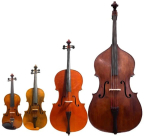
Violin cases are usually offered for 4/4, 3/4, 1/2, 1/4 and smaller children's instruments.
| Violin size | Typical player | Recommendation |
|---|---|---|
| 4/4 | Adults and teenagers | Full-size 4/4 case |
| 3/4 | Older children | 3/4 case or confirmed compatible model |
| 1/2 | Younger students | 1/2 compatible case |
| 1/4 and smaller | Younger children | Case designed for the exact instrument size |
A 4/4 violin case is designed for a standard full-size violin. Consider internal dimensions, weight, bow holders and carrying options.
For children's instruments, low weight and comfortable straps are particularly important.
A rectangular case often provides more accessory storage.
A shaped case follows the outline of the violin and is usually more compact.
Wooden cases: Traditional rigid construction.
Plastic cases: Various shapes and finishes.
Composite cases: Designed to combine strength and low weight.
Textile bags: Lightweight and practical.
The violin should sit securely inside the case without excessive movement, and closing the lid must not place pressure on the bridge.
A traditional handle suits short-distance carrying, while shoulder or backpack straps can be more comfortable for longer journeys.
It is important to distinguish between water-repellent, water-resistant and waterproof construction.
Do not assume that a case is fully waterproof unless the manufacturer specifically states this.
Wooden violins react to changes in temperature and humidity.
A standard case cannot maintain stable climatic conditions indefinitely.
Never leave a violin in a hot parked car or in severe frost.
A beginner mainly needs the correct size, stable internal support and simple handling.
A semi-rigid or hard case with soft lining and bow storage can be a practical choice.
Players who travel frequently may place greater emphasis on mechanical protection, weight and practical internal organisation.
When travelling by air, always check the current musical-instrument policy of the airline.
Correct size, reliable construction and clear product information are important when choosing a violin bag or case. Clear specifications help you select a solution that suits your instrument and the way you use it.
Give your violin suitable protection during everyday transport and storage.
A soft bag generally has a padded textile construction, while a hard case uses a rigid protective structure.
Choose the correct size, stable internal support, easy closure and comfortable carrying system.
Only if the manufacturer confirms compatibility and the interior safely secures the smaller instrument.
Choose a case marked 1/2 or a model specifically confirmed as compatible.
It generally provides greater resistance to pressure and impact, depending on construction quality.
It is a shaped case that offers a compromise between a soft bag and a hard case.
Rectangular models often provide more storage, while shaped cases are usually more compact.
No.
Only to a limited extent.
It depends on the specific case.
Yes, if the case provides suitable space.
Yes, provided they are properly adjustable and securely attached.
It depends on the specific construction and model.
Yes, subject to the airline's current baggage and musical-instrument rules.
It should sit securely without excessive movement and without pressure on the bridge, neck or other sensitive parts.
Follow the manufacturer's recommendations for the specific material.
Consider replacement if the construction, closures, handles, straps or internal support can no longer hold the instrument safely.
Whether you need a 4/4 violin case, a children's 1/2 case, a lightweight violin bag or a hard case for regular travel, focus on correct size, construction quality and internal padding.
Choose a solution that suits your violin, your travel habits and your storage requirements.
No results returned from filter